Last Updated: April 2026 | Reviewed by Alex Hunter, Senior SaaS Editor
SEMrush Review 2026: The Best All-in-One SEO Suite for Growth Teams?
SEMrush is the “Swiss Army knife” of SEO. It’s not the cleanest UI, and it’s not the cheapest subscription—but it’s the tool many growth teams end up using because it compresses a lot of workflows into one place: keyword research, competitor tracking, site audits, content planning, link analysis, and even PPC insights.
The real question in 2026 isn’t “Can SEMrush do SEO?” (it can). It’s: do you need an all-in-one platform, or are you better off with a sharper single-purpose tool like Ahrefs for links or a simpler keyword tool plus a crawler?
Table of Contents
Quick Comparison: SEMrush vs Ahrefs
| Tool | Best For | Strength | Tradeoff |
|---|---|---|---|
| SEMrush | All-in-one SEO + PPC workflows | Keyword + competitor toolkit depth | UI complexity + limits |
| Ahrefs | Link analysis + content discovery | Backlink dataset + explorer UX | Less “suite” breadth |
What Is SEMrush?
SEMrush is a SaaS platform that helps you plan, execute, and monitor SEO. It combines:
- Research: keywords, domains, competitors, SERP features, intent.
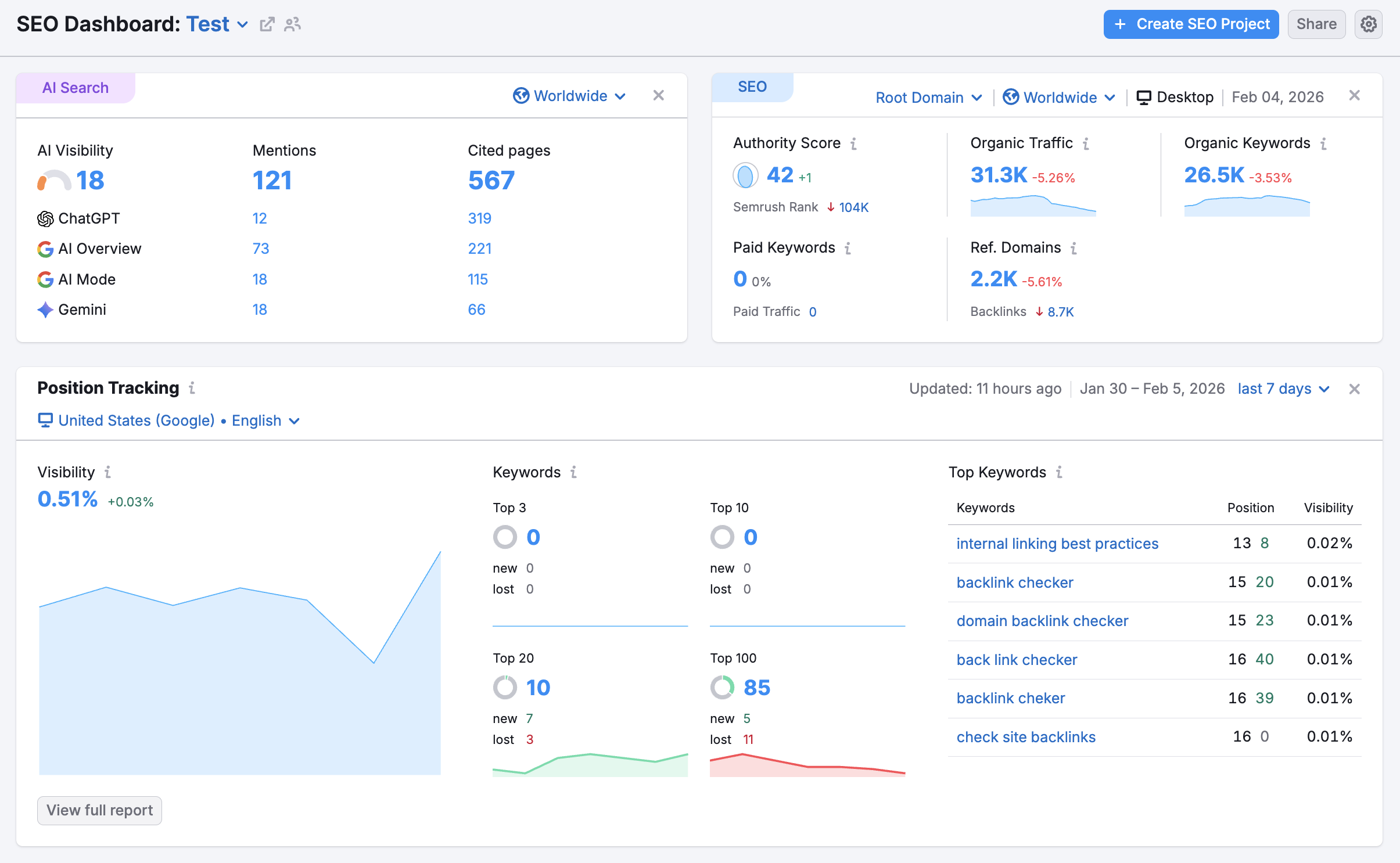
- Tracking: rankings, visibility, site health, and project monitoring.
- Execution: audit workflows, on-page checks, content briefs, and reporting.
In 2026, SEMrush is particularly strong for teams that treat SEO like a system—not a one-time task. If you publish consistently, track a portfolio of pages, and run regular technical checks, SEMrush can replace multiple smaller tools.
Keyword Research: Where SEMrush Earns Its Keep
SEMrush’s keyword tooling is built for decision-making, not just “idea lists.” The most practical value comes from combining:
- Intent signals: informational vs commercial vs navigational.
- SERP features: where Google is stealing clicks (AI answers, snippets, videos).
- Difficulty context: can you realistically rank with your current authority?
How we’d use SEMrush for SaaS review SEO
- Start from “money pages” (e.g., “best CRM for small business”, “[Tool] pricing”, “[Tool] vs [Tool]”).
- Build clusters: reviews + comparisons + “how to” tutorials.
- Use keyword variations to cover intent: “pricing”, “alternatives”, “review”, “setup”, “templates”.
Competitor Intel & Content Gaps (The Hidden Superpower)
For most teams, the fastest path to traction is not “brainstorm content.” It’s: find competitors already getting traffic, then identify the gaps you can exploit. SEMrush helps with that by showing:
- which pages drive traffic to a domain,
- which keywords you’re missing,
- where you’re ranking 8–20 (quick wins),
- and where your content is cannibalizing itself.
If you run a niche directory/review site, this matters because you win with coverage and internal linking, not with “one viral post.” SEMrush makes that planning structured.
Site Audit: Technical SEO Without Guesswork
The Site Audit is valuable if you treat it as a recurring maintenance checklist. It flags issues like:
- broken internal links and redirects,
- duplicate titles and meta descriptions,
- missing canonical tags (depending on setup),
- performance and crawlability signals,
- thin content and orphan pages.
For small sites, audits are overkill unless you run them quarterly and actually fix the prioritized items. For larger sites (hundreds/thousands of pages), the audit becomes your “SEO operations dashboard.”
Content Workflow: Briefs, Optimization, and Teams
SEMrush is more than research. It’s also workflow for teams shipping content:
- Topic planning: cluster maps and coverage gaps.
- Briefs: outline suggestions, entities, and on-page checks.
- Reporting: client-facing or stakeholder dashboards.
This is especially useful for agencies: clients don’t pay for “SEO ideas,” they pay for consistent output with measurable improvements.
Backlinks: Good Enough or Not?
SEMrush’s backlink tooling is strong, but in many teams it’s “good enough” rather than “best-in-class.” If link building and link analysis are your core game, Ahrefs often feels more purpose-built. If you mostly need to monitor backlinks, identify toxic patterns, and compare competitor link profiles at a high level, SEMrush covers that.
Pricing & Hidden Limits (The Part That Surprises Teams)
Most SEO suites feel expensive because they price on limits, not just features. Typical limits include:
- tracked keywords,
- projects,
- crawl budget for audits,
- reports and exports,
- user seats.
So the question isn’t “Can we afford the monthly bill?” It’s: will we hit the limits once we scale content and tracking?
Who SEMrush Is Best For
- Growth teams that need one platform for research + audits + tracking.
- Agencies that must report and plan content systematically.
- Teams doing SEO + PPC (SEMrush helps unify competitive data).
- Operators who will use the tool weekly (not “once a quarter”).
Who Should Avoid It
- Teams that only need backlink analysis (Ahrefs may be a cleaner buy).
- Very small sites that won’t use audits/tracking consistently.
- Solo creators who want a minimal UI and a simple keyword list tool.
Final Verdict
SEMrush is a powerful all-in-one SEO suite that rewards teams with process. If you want a single place to run keyword research, competitor analysis, technical audits, and rank tracking, it’s one of the safest buys in SEO. If you only need one specific capability (like links), you might get better ROI with a more specialized tool.
Try SEMrush →